
Foldable smartphones no longer surprise anyone, voice assistants are part of the furniture, and artificial intelligence writes emails for us. The tech landscape this year is not limited to incremental updates. Several technical shifts are changing the way we use our devices, create content, and how the law regulates these uses. Here are the areas that deserve the attention of enthusiasts, beyond catch-all lists.
Transparency obligations of the AI Act: what changes concretely for users
Have you ever chatted with a chatbot without knowing if a human was behind the screen? Since August 2, Article 50 of the European AI Act imposes transparency rules on any artificial intelligence system deployed in the European Union. This regulation does not primarily target research laboratories. It affects the consumer tools that millions of people use every day.
Chatbots and conversational agents must now clearly inform the user that they are interacting with an AI, unless the context makes it obvious. Content generation systems (text, image, audio, video) must apply a technical marking to their productions: watermarking and machine-readable metadata. The goal is to allow any downstream tool to detect that content is artificial.
For enthusiasts, this translates into a concrete change: AI-generated images on social networks or creative platforms will carry a detectable signature. Deepfakes disseminated on topics of public interest must be identified as such, unless a physical person takes editorial responsibility for them. Emotion recognition systems or biometric categorization must also notify exposed individuals.
This regulatory framework deserves close attention, as it redefines the boundary between human content and synthetic content across Europe. If you regularly follow Série Live’s tech content, you will find analyses on these topics over the coming months.
Multi-agent systems and specialized AI: beyond the single chatbot

The model of the generalist chatbot that answers everything is starting to show its limits. The underlying trend this year concerns multi-agent systems, where multiple artificial intelligences collaborate to accomplish a complex task. Each agent specializes in a specific area (planning, information retrieval, execution) and communicates with the others.
Imagine a simple request: organizing a trip. One agent searches for flights, a second compares accommodations based on your criteria, and a third checks the administrative formalities of the targeted country. Each works within its scope and transmits its results to the others. The final result is more reliable than a single response produced by one generalist model.
At the same time, specialized language models are gaining ground against massive models. Rather than training a network on the entirety of human knowledge, some companies are developing lighter models focused on a specific sector: law, medicine, engineering. A specialized model consumes fewer resources and produces more accurate responses in its field. For a tech enthusiast, this means faster, more relevant, and less energy-consuming tools.
Edge AI and local processing: why your next device will compute without the cloud
The majority of current smart assistants send your data to remote servers for processing. This model works, but it introduces latency, consumes bandwidth, and raises privacy concerns. The opposite trend is rapidly progressing: AI processing directly on the device, without a cloud connection.
Recent chips integrated into smartphones, laptops, and even some connected objects include neural processing units (NPU). These components execute AI models locally. Voice recognition, photo processing, and real-time translation then function without sending data outside.
The concrete benefits for the user:
- Responsiveness significantly increases, as processing no longer depends on the quality of the internet connection or the distance to the server
- Personal data remains on the device, reducing exposure to leaks and interceptions
- The device continues to function intelligently even offline, on an airplane or in a dead zone
This evolution does not replace the cloud for massive tasks, but it redistributes roles. The cloud becomes a complement, not a dependency. Enthusiasts choosing a new smartphone or laptop this year should check for the presence and power of the integrated NPU.
Generative reality and spatial interfaces: content that adapts in real-time
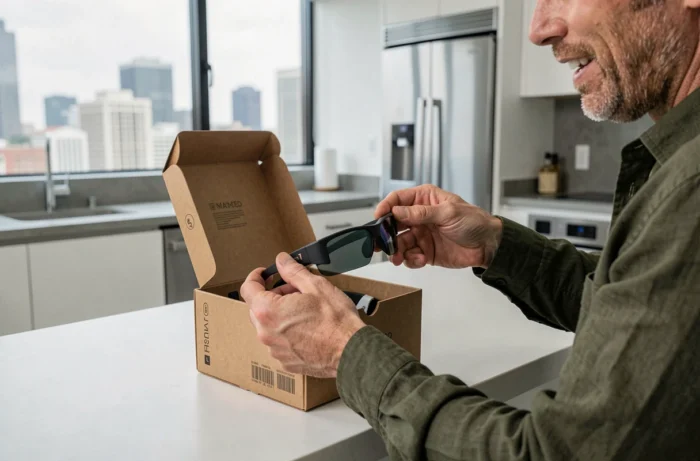
Augmented reality and virtual reality are no longer confined to the bulky headsets of the early days. Next-generation smart glasses integrate overlays to the real world, powered by AI. What changes this year is the ability of these systems to generate content in real-time rather than displaying pre-recorded elements.
The concept of generative reality pushes this logic further. AI models transform data streams into immersive environments that evolve continuously. In video gaming, this translates into worlds where settings, characters, and plots adapt to the player’s choices and preferences.
Some publishers are experimenting with autonomous virtual characters capable of forming relationships with each other and with the player, creating persistent virtual societies. Other platforms allow transforming text instructions into explorable 3D worlds. These technologies remain in active development, but they outline a future where digital content is no longer static.
For everyday interfaces, eye tracking and gesture recognition are gradually replacing buttons and menus. Interaction becomes spatial and intuitive, opening applications in entertainment, remote work, or technical training.
Where to focus your attention this year
The trends that deserve regular monitoring are not necessarily the most spectacular. The European AI Act imposes a framework that will transform how synthetic content circulates online. Multi-agent systems and specialized models are changing the quality and reliability of AI tools accessible to the general public. Local processing on devices reshapes the balance between performance, privacy, and autonomy. And generative reality is beginning to deliver on its promises in concrete use cases.
Following these four areas allows us to understand not what tech promises, but what it actually delivers to users this year.