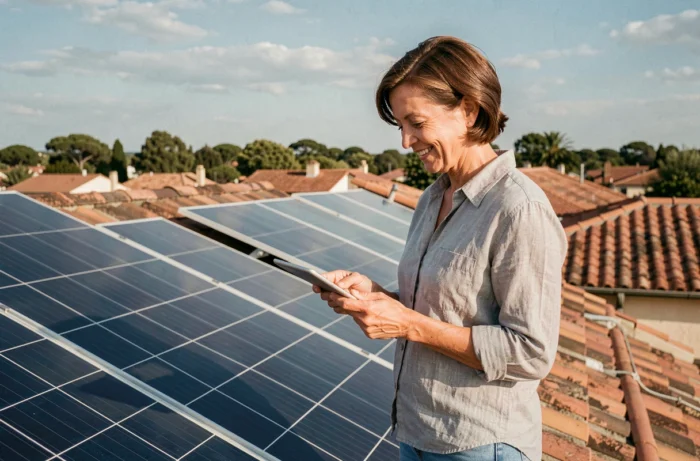
Solar energy to reduce your electricity bill is based on a simple technical principle: photovoltaic panels convert sunlight into direct current, which is transformed into alternating current by an inverter, and then injected directly into the home network. This current powers the devices in operation at the time of production, which decreases the amount of electricity purchased from the supplier.
S21 Tariff Scheme: What Changes for a Residential Solar Installation
Most guides on solar self-consumption still present an economic model based on an investment grant and an attractive surplus buyback rate. This framework has changed significantly.
The self-consumption grant has been abolished for applications submitted from June 5, 2026, as part of the new S21 tariff decree published in the Official Journal on June 4, 2026. The surplus buyback rate has been lowered in the same text.
Another structural change: total sale is no longer accessible for residential installations under 9 kWc. Only self-consumption with surplus resale remains possible for this power range. In practical terms, an individual who installs solar panels on their roof can no longer sell all of their production at a guaranteed rate. They must consume part of what they produce.
This shift changes the investment logic. The return on investment now depends more on the actual self-consumption rate than on the buyback rate. The higher the share of solar electricity consumed on-site, the lower the bill. The less the household self-consumes, the less the surplus sold brings in, and the longer the financial return takes.
Players like Energie O’ Solr support this transition by guiding individuals towards configurations suited to their actual consumption profile, rather than towards a maximum sizing.

Solar Self-Consumption Rate: The Parameter That Determines Profitability
The self-consumption rate refers to the proportion of electricity produced by the panels that is directly used in the home. A household that consumes the majority of its solar production significantly reduces its energy bill. A household that is absent during the day, with few devices operating during sunlight hours, lets most of its production go as poorly compensated surplus.
Adapting Usage to Production Hours
The first method to increase this rate costs nothing: shift energy-intensive uses to solar production slots. Running the washing machine, dishwasher, or water heater in the middle of the day rather than in the evening significantly changes the equation.
Some solar management boxes automate this control. They detect production peaks and trigger compatible devices. Storing in a hot water tank remains the most cost-effective solution for absorbing a temporary surplus, because the cost of a tank is marginal compared to that of a home battery.
Home Battery: A Calculation to Make Before Buying
Lithium batteries allow for storing excess solar energy to be used in the evening. Their cost remains high and their lifespan is limited compared to that of the panels. The financial gain depends on the difference between the price of purchased electricity and the storage cost per kWh. With the decrease in the buyback rate under the S21 regime, the battery becomes more relevant than before, but only for households with high evening consumption.
- A household with high daytime consumption (teleworking, heat pump) benefits more from direct self-consumption without a battery.
- A household absent during the day but very consumption-heavy in the evening may justify the investment in a battery, provided the cost per charge cycle is checked.
- The coupling of solar panels and electric vehicle charging during the day constitutes a use case where the self-consumption rate naturally rises.

Sizing Solar Panels: Avoiding Oversizing
Installing too much power compared to actual consumption is a common pitfall. With the disappearance of the grant and the decrease in the buyback rate, each excess kWc installed relative to actual needs generates poorly valued surplus.
An appropriately sized installation covers between half and three-quarters of the household’s annual consumption. Beyond that, the surplus increases without proportional financial compensation. A serious installer analyzes consumption curves (Linky readings over twelve months) before proposing a power size.
Orientation, Tilt, and Solar Shading
The efficiency of an installation depends on three physical parameters: the orientation of the roof (south-facing remains suitable), the tilt (around 30 degrees in mainland France), and solar shading (trees, neighboring buildings, chimneys). An east-west oriented roof produces less per panel but spreads production throughout the day, which can improve the self-consumption rate.
Before any installation, a shading study identifies shadow areas that reduce production. A partially shaded panel can penalize the entire system if the installation does not have micro-inverters or power optimizers.
French Photovoltaic Park: Growth Despite Regulatory Adjustments
The growth of the French photovoltaic park reflects a lasting interest from individuals and professionals, despite successive reforms of the regulatory framework.
The abolition of the self-consumption grant has slowed some investment decisions. Industry professionals observe a phase of adjustment rather than a collapse. Households that are equipping themselves today do so with a more realistic view of profitability, based on the direct reduction of their electricity bill rather than on a subsidy mechanism.
Switching to solar energy in 2026 remains a concrete lever for reducing energy bills and decreasing the carbon footprint of a home. The regulatory framework simply requires sizing the installation with more rigor than before, based on the actual consumption of the household rather than on a promise of theoretical yield.