
Norway is part of the European Economic Area but not the EU customs union. This distinction changes everything for the importer: a customs declaration remains mandatory even if the duties are zero. Ignoring this point can lead to the vehicle being blocked at the border or delaying registration by several weeks.
Distinction between EEA and customs union: the administrative trap of Norwegian imports
Consumer articles merely mention that Norway is “outside the EU.” The regulatory reality is more nuanced. The EEA agreement guarantees the free movement of goods with reduced or zero customs duties on vehicles benefiting from preferential origin. However, the lack of membership in the customs union imposes a formal customs clearance.
Specifically, the vehicle must be presented at the customs office upon entry into the EU (often in Denmark or Germany if you are transiting by road). You must submit a customs declaration (DAU) along with the purchase invoice, the Norwegian registration certificate, and, if applicable, proof of preferential origin (EUR.1 or invoice declaration). Without this origin document, standard duty rates may apply.
We recommend preparing the customs file before the vehicle departs, particularly by ensuring that the seller can provide proof of origin. This detail, rarely mentioned in guides, avoids a tariff adjustment upon arrival. To delve deeper into the complete procedure, we have compiled our tips for importing a car from Norway based on files processed in recent years.
Import VAT and tax clearance: what has changed since 2022

A vehicle imported from Norway is subject to French VAT, regardless of its age or mileage. The Norwegian VAT paid at purchase is not transferable: you start from scratch on the tax side in France.
Since 2022, import VAT is self-assessed on the VAT declaration for taxable persons. Individuals, however, must still pay VAT at customs clearance or to the business tax service (SIE). In both cases, obtaining the tax clearance certificate (certificate 846A) remains a prerequisite for any request for a registration certificate.
The tax clearance certifies that the vehicle’s VAT situation is regularized. To obtain it, present the purchase invoice, the customs document, and the foreign registration certificate to the SIE. Without the tax clearance, no prefecture or authorized service provider will accept your registration file.
Technical inspection and certificate of conformity for a Norwegian vehicle
The Norwegian technical inspection (EU-kontroll) is not recognized in France. You must have a French technical inspection done at an approved center before any request for a registration certificate. The vehicle must comply with French standards, which rarely poses a problem for recent European models but may be an issue for details like permanent daytime running lights or the absence of headlight range adjustment.
The European certificate of conformity (COC) is the other necessary technical document. A vehicle initially marketed in Europe usually has a COC issued by the manufacturer. If the Norwegian seller does not provide it, you can order it directly from the manufacturer or a specialized provider. Without a COC, the DREAL will have to conduct an isolated reception, a lengthy and costly procedure that may include technical modifications.
- Check for the presence of the COC before purchase: it is the document that determines whether registration will be simple or complex.
- Ask the seller for the report of the last EU-kontroll to anticipate any potential points of non-compliance with French standards.
- Plan a French technical inspection in the days following the vehicle’s arrival, as the provisional registration certificate (CPI WW) requires a valid technical inspection.
Transport and logistics: road, ferry, or flatbed truck
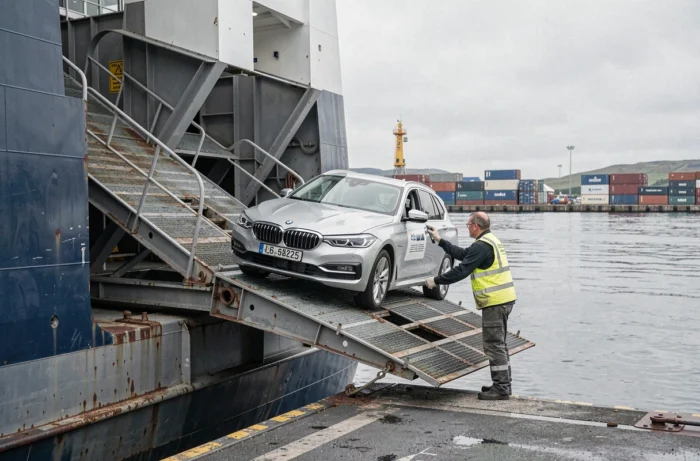
Driving the vehicle from Norway to France covers about 2,000 kilometers via Sweden and Denmark. This is the cheapest option, but it requires that the vehicle is insured for transit and that you have a Norwegian transit or export plate. Norwegian transit plates are temporary and issued by Statens vegvesen.
The alternative is transport on a flatbed or by roll-on/roll-off ferry (ro-ro). The ferry from Kristiansand or Oslo to Denmark, followed by a flatbed truck to France, remains the safest solution for a valuable vehicle. The cost of transport varies greatly depending on the distance and mode chosen, but it rarely exceeds the cost of taxes and administrative formalities.
- Insure the vehicle as soon as you purchase it: a “transit” insurance covers the journey between Norway and France.
- Keep all transport documents (CMR or bill of lading): customs may require them.
- If you go through a freight forwarder, ensure they handle the customs declaration upon entry into the EU.
Norwegian electric vehicles: a special case to anticipate
Norway has an exceptional proportion of electric vehicles in its used car market. Importing a Norwegian EV to France offers a significant price advantage but requires checking the compatibility of the onboard charger with the French network (CCS Combo 2 plug, standard in Europe) and the manufacturer’s warranty, which may be limited to Norwegian territory for certain models.
The certificate of conformity for an EV mentions the specifications of the battery and the emissions (none). This point facilitates registration, as electric vehicles are exempt from the ecological penalty and benefit from reduced registration fees in most French regions.
The Norwegian used electric vehicle market is rapidly renewing. Models two or three years old are priced significantly lower than those in France for equivalent mileage and condition. It is precisely this rapid depreciation, linked to the abundant supply in Norway, that makes importing financially relevant despite the administrative burden of the process.