The Côtes-d’Armor alone concentrate more than 1,700 cleaning companies registered under codes 81.21Z and 81.22Z. This figure, recorded in September 2026, places Brittany among the densest regions in France for the cleanliness sector. This regional structuring, driven by local SMEs and mid-sized companies, shapes a market where proximity is not a commercial argument but a daily operational constraint.
Specifications and cleaning protocols for tertiary sector in Brittany
A Breton service provider working in traditional tertiary settings (offices, open spaces, meeting rooms) rarely operates on a simple schedule of visits. The detailed specifications remain the reference document, and its drafting conditions both perceived quality and actual quality.
We observe that structured local companies systematically distinguish three levels of service: regular maintenance, deep cleaning, and restoration. Regular maintenance covers vacuuming, dusting of work surfaces, emptying bins, and disinfecting restrooms. Deep cleaning includes mechanized floor washing, periodic stripping, and treatment of textile coverings.
Restoration, on the other hand, concerns end-of-site cleaning or tenant changes. This categorization is not cosmetic: it determines the equipment used, the qualifications of the agents, and the frequency of intervention.
Traceability of visits via geolocated time tracking tools constitutes another quality lever. Several Breton service providers now equip their agents with NFC badges or timestamped mobile applications. The client has access to a verifiable history, which reduces disputes and allows for frequency adjustments based on actual data rather than perception.
The professionals listed on Bretagne Net illustrate this density of local players capable of meeting demanding specifications, from traditional tertiary to agri-food sectors.
Industrial and agri-food cleaning: specific Breton constraints
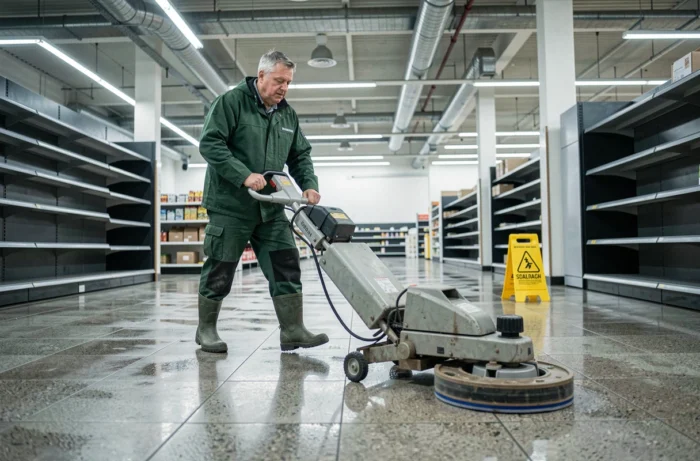
Brittany concentrates a significant share of the French agri-food industry. Cleaning companies operating in this sector apply much stricter disinfection protocols than in the tertiary sector.
Agri-food cleaning requires complete traceability of the products used, with safety data sheets accessible at all times on site. Agents must master HACCP procedures and be aware of chemical incompatibilities between detergents and food surfaces.
We recommend checking three points before contracting with a provider for this type of site:
- The effective HACCP training of assigned agents, not just the management. A trained team leader guarantees nothing if the operators in contact with production areas are not trained.
- The ability to intervene during off-peak hours, often between production cycles, with time slots of only a few hours. Reactivity is measured here in minutes, not days.
- The management of biocidal products and their compatibility with site certifications (IFS, BRC). A provider who cannot provide the list of their approved products before the contract starts lacks rigor.
Structured Breton players, such as the Société Bretonne de Nettoyage or the regional agencies of Groupe Vert, have specialized divisions for this type of intervention. This specialization is not a luxury: it reflects the economic reality of a region where agri-food generates a constant demand for industrial cleanliness.
Daytime work and retention of cleaning agents
The cleanliness sector has historically suffered from high turnover, exacerbated by fragmented hours (early morning, late evening). In Brittany, several companies have begun to shift towards continuous daytime work or late afternoon shifts.
Recent job offers for tertiary cleaning agent positions in Brittany explicitly mention time slots from 12 PM to 5 PM or from 3 PM to 8 PM. This change is not trivial: it allows agents to work in the presence of the occupants of the premises, which alters the client relationship and enhances the profession.
For the client, the benefit is twofold. First, a stable agent knows the premises and the specific requirements of the site, which reduces oversights and rework. Second, daytime presence facilitates direct communication between the agent and the client representative, without always going through a team leader or account manager.
PH+, based in Ille-et-Vilaine, has made daytime work a structuring axis of its HR policy. This positioning attracts more qualified profiles and mechanically reduces the replacement cost associated with turnover.
Criteria for selecting a local cleaning provider
A quote alone is not enough to evaluate a provider. A low price often masks understaffing or insufficient frequencies. We recommend structuring the comparison around operational criteria rather than financial ones.
- The agent/surface ratio: a serious provider sizes its teams based on the square meters to be treated and the level of service required, not based on the available budget.
- The presence of an identified quality manager, distinct from the sales team, with documented regular checks.
- The ability to provide a continuity plan in case of absence (illness, vacation). A locally established provider with multiple teams can better absorb unforeseen events than a solitary operator.
- Verifiable CSR commitment: waste sorting, use of eco-labeled products, reduction of packaging.
Window cleaning and complementary services
Window cleaning remains a distinct service that requires specific equipment (telescopic poles, lifts for high work) and particular qualifications. In Brittany, where the maritime climate accelerates the soiling of glass surfaces, the frequency of window cleaning must be higher than the national average to maintain an acceptable result.
Local providers generally incorporate this climatic variable into their quotes, which explains pricing discrepancies with national players who apply standardized grids.
The Breton fabric of professional cleanliness stands out for its density, sector specialization, and the gradual adoption of HR practices that stabilize teams. For a client, choosing a structured local provider remains the best guarantee of a service adapted to the real constraints of the site.