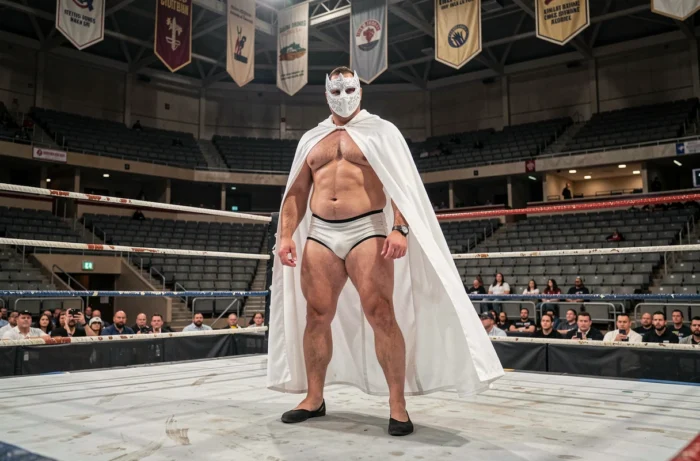
The White Angel is the most famous masked wrestler in the history of French wrestling. Appearing in the ring at the Cirque d’Hiver on January 7, 1959, this wrestler dressed in white from head to toe crystallized the hopes of a country in the midst of reconstruction. Behind the mask was Francisco Pino Farina, a man whose dual Franco-Spanish nationality was only confirmed long after the end of his career.
Measuring the extent of this phenomenon requires comparing what is known about the man to what the legend has created.
Francisco Pino Farina vs. the character of the White Angel: what the facts reveal
| Element | Francisco Pino Farina (the man) | The White Angel (the character) |
|---|---|---|
| Announced origin | Spain (born in the 1930s) | Presented as Venezuelan by Roger Couderc |
| Identity | Known to promoters and the Federation | Completely secret to the public |
| Number of mask bearers | One man originally | Several wrestlers under the same mask on the same night |
| Fighting style | Aerial style close to lucha libre | Angel-like avenger, punisher of “bad boys” |
| Main activity period | Late 1950s to 1960s | Legend still active in collective memory |
This table highlights a fundamental gap. The character quickly surpassed the man who wore it. The Venezuelan origin announced by commentator Roger Couderc was a narrative fabrication, a dramatic device that added exoticism to the mystery of the mask. The reality of a Spanish wrestler settled in France was less romantic, but it is precisely this gap between reality and fiction that fueled the fantasy for decades.
To delve deeper into the story of the White Angel wrestler and understand how the mask became established in the French imagination, one must look back at the cultural context of that time.
The mask as a prototype of French wrestling against the American model
Content that deals with the White Angel focuses on nostalgia and anecdote. They miss a point that recent analyses of the popularity of wrestling in France document: The White Angel serves today as a historical reference in debates about the identity of French wrestling in relation to the American model.
The wrestling as it was practiced in France in the 1950s-1960s relied on a readable moral code. The masked wrestler embodied good, while his opponents (the Executioner of Béthune, for example) embodied evil. The matches followed a simple dramaturgy where justice triumphed.
This model differs profoundly from the American tradition, built on complex storylines, alliances shifting, and an industrialized television spectacle. The White Angel represents a local wrestling:
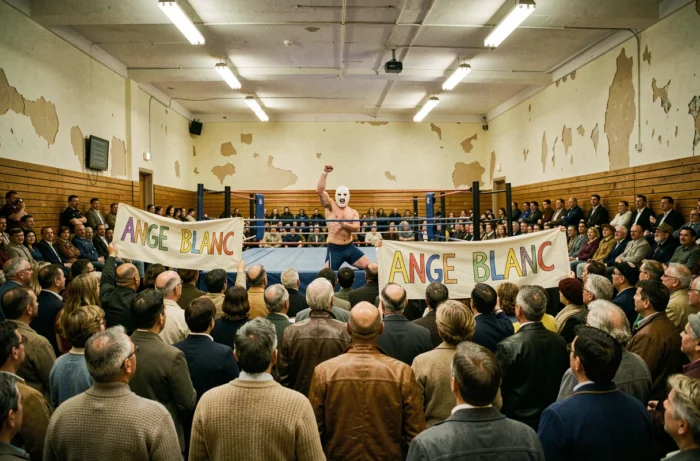
- Matches organized in circuses, community halls, and municipal gyms, not in giant arenas
- A single commentator (Roger Couderc) whose voice was enough to transform a match into a national epic
- A character whose mystery relied on the total absence of information, unlike the media-overexposed American wrestlers
The comparison between these two traditions sheds light on why French wrestling has never replicated the economic model of American wrestling. The character of the White Angel operated within a handcrafted ecosystem. Several wrestlers could wear the white mask on the same night, in different cities, because the system relied on collective belief, not on the traceability of an identified star.
The role of the Federation and the multiplication of White Angels
The most revealing detail about the functioning of French wrestling at that time concerns the management of the character by the Federation. Several different wrestlers simultaneously wore the mask of the White Angel. This was not a secret among insiders; it was an economic model.
The audience of the 1960s accepted, or pretended to accept, that the White Angel could fight on the same night in Lille and Marseille. This voluntary suspension of disbelief recalls the functioning of popular fiction heroes. The mask did not belong to Francisco Pino Farina; it belonged to the public.
A social fantasy more than an athlete
Contemporary testimonies describe unique scenes: women kneeling as the wrestler passed by, spectators kissing his hands. The White Angel functioned as a quasi-religious figure in a France still marked by the post-war period.
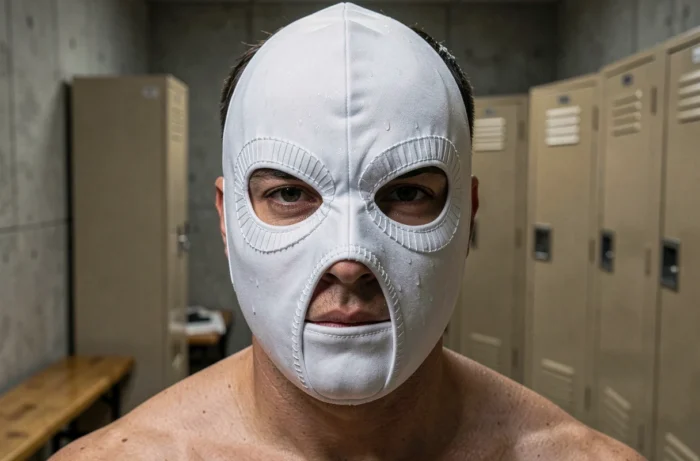
This phenomenon goes beyond the sporting realm. It pertains to a collective social fantasy, that of an anonymous, selfless avenger whose sole mission is to punish the “bad boys.” The white cape, the immaculate mask, the absence of a face: everything converged towards a figure of a purifying angel that American wrestling, too entrenched in the star system, has never produced.
Memory and archives of the White Angel: traces beyond the ring
The library network of Caen references a work titled Memorandum for the White Angel by Joël Dupont and Pierre Leberruyer, published in 2001. This type of document attests that the figure of the White Angel has been the subject of serious editorial treatment, surpassing mere nostalgia from internet forums.
The difference between a fad and a legend lies in the persistence of traces. The White Angel has traversed more than six decades of French collective memory without ever showing his face. It is precisely this absence of identity that has guaranteed the longevity of the myth. An identified wrestler ages, retires, becomes a has-been. A white mask remains suspended outside of time, available for each generation that wants to project its own expectations onto it.