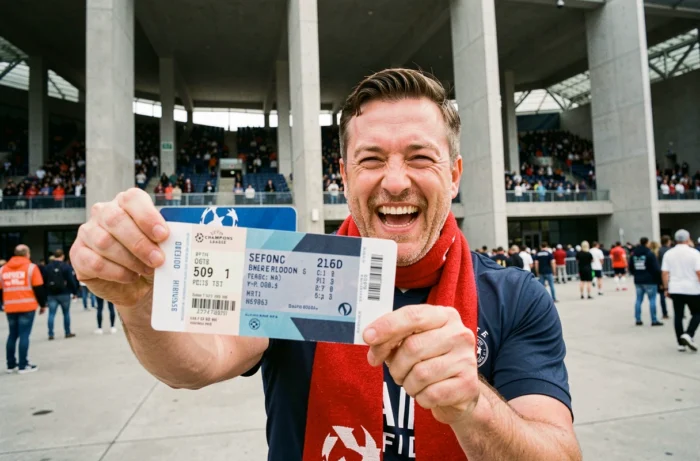
Each season, the Champions League final attracts a demand for tickets that far exceeds the available supply. For the 2027 edition, scheduled for June 5 at the Estadio Metropolitano in Madrid, the access rules have evolved again. Named tickets, enhanced checks, a shift to fully digital: the purchasing process is increasingly resembling an administrative procedure rather than a simple transaction, which is better anticipated.
Named tickets and identity checks: what has changed since 2025
The first obstacle is no longer the price or the speed of the click, but the identity verification. At recent finals, particularly in Budapest, organizers deployed three concentric security rings around the stadium. The first check occurs at a perimeter zone located about a hundred meters from the venue, well before the turnstiles.
At each ring, the match between the ticket and the identity documents of the holder is verified. A ticket purchased from a third party whose name does not match yours is therefore likely to be refused even before approaching the gates.
This system, used as a model for matches classified as “very high risk” in Europe, is systematically applied to Champions League finals. For the supporter, the consequence is direct: an informally resold ticket becomes a very risky bet. The most reliable approach remains to go through the ticket office for the Champions League final via the official UEFA or qualified club channels.

100% mobile ticket: the end of PDF and screenshot
Since the 2025-2026 season, several clubs and organizers have switched to mobile-only tickets, locked to a phone and a verified account. Screenshots, PDF prints, and paper tickets no longer pass through the turnstiles.
The ticket is linked to the official app of the club or UEFA. It is dynamically generated with a QR code that changes at regular intervals, preventing any duplication. If you change your phone between the purchase and the match day, you must transfer the ticket via the app, with a new identity verification.
Preparing your phone on the day
- Check that the app is up to date and that the ticket is displayed before leaving the hotel or airport, as mobile networks become congested near the stadium.
- Fully charge the battery or bring an external battery: a dead phone equals a lost ticket.
- Save the ticket in the app’s offline mode if this option exists, so you don’t depend on the connection at the moment.
This shift to fully digital protects against counterfeiting, but it also creates a technical fragility that many supporters underestimate.
UEFA allocation and club quotas: how tickets are distributed for the final
UEFA reserves a portion of the tickets for direct sale to the general public, through a lottery on its official website. The rest is distributed among the two finalist clubs, federations, sponsors, and commercial partners. During the 2026 final in Budapest, PSG received an allocation of 17,200 tickets, which is a slightly lower quota than the previous year due to a smaller stadium.
For supporters of a qualified club, the sale generally takes place in several waves:
- Season ticket holders with a high attendance history are served first in the first wave.
- Members of the club’s loyalty program access a second wave, often within a few hours.
- The remaining tickets, when available, are sometimes opened to a wider audience through an internal lottery at the club.
A supporter who is neither a season ticket holder nor a loyalty member thus faces a very narrow funnel. Signing up for their club’s program several months before the final, even without certainty of qualification, remains the only way to enter the priority circuit.
Secondary market and resale: traps to identify
The temptation of the secondary market exists, especially when official channels are exhausted. However, the risks have significantly increased in recent seasons. Named tickets and the locked mobile format make resale between individuals technically difficult, if not impossible.
Some resale platforms present themselves as “authorized,” but UEFA does not recognize any third-party resellers for its finals. A ticket purchased on these sites can be canceled without notice if the organizer detects that it has transited outside the official circuit. Field reports show that supporters have been denied entry after paying several times the initial price on unapproved platforms.
Common scams to watch out for
The most common formats include fake PDF tickets, copied QR codes that only work once (the first to scan gets in, not necessarily the buyer), and ads on social media with payment by bank transfer without recourse.
The only secure resale goes through the official resale platform of UEFA or the club, when it exists. These platforms verify the identity of the seller and the new buyer, then generate a named ticket in the name of the latter.
Purchase timeline and anticipation for the 2027 final in Madrid
For the final scheduled at the Estadio Metropolitano on June 5, 2027, the sales timeline follows a predictable pattern. UEFA first opens applications for the public lottery several weeks before the match. The finalist clubs then launch their own sales in the days following the semi-finals.
Registering as soon as the UEFA lottery opens mechanically increases the chances, even if they remain low considering the volume of applications. The available data does not allow for a precise success rate to be quantified, but the gap between demand and supply counts in the tens of thousands of applications for a few thousand tickets.
Anticipating also means planning the logistical aspect: accommodation, transport, and especially a phone compatible with the mobile ticketing system. These details, settled too late, can turn a ticket obtained into a missed evening.