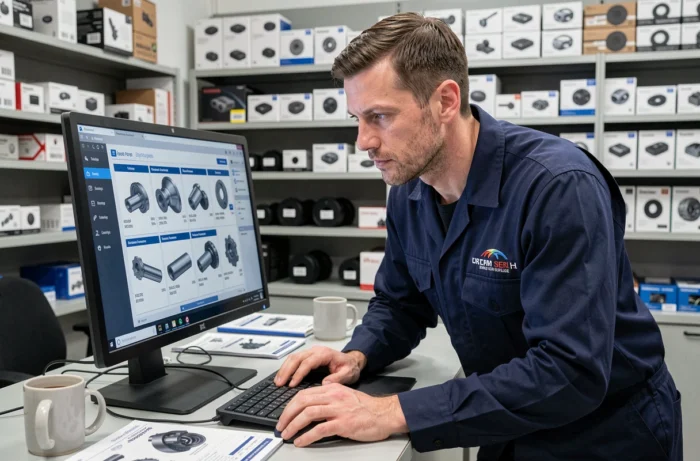
Dialogys, the parts and technical documentation catalog of Renault, has undergone a silent transformation. The old installable software, with its last downloadable version dating back to late 2019 (version 4.90), has been replaced by New Dialogys, a centralized web portal that is continuously updated. For anyone looking for a part reference on a Renault or Dacia vehicle, the access path has changed in logic, and the terms of use are not always clear.
VINsearch and multi-brand access: a parallel entry point to Dialogys Renault
The available content on the subject focuses almost entirely on the official portal newdialogys.renault.com. A third-party provider, VINsearch, offers a different approach: an aggregated access to Dialogys Renault and Dacia via a single login, alongside other manufacturer catalogs like ETKA, EPC Mercedes, or GM EPC.
This type of cross-offer is particularly interesting for independent garages that work on multiple brands. Instead of managing a subscription per manufacturer, a mechanic can view exploded diagrams for Renault and switch to a Volkswagen catalog in the same session. The documented plans in 2026 include daily passes, monthly, and annual subscriptions.
For an individual or a professional wishing to access Dialogys Renault online, this alternative is worth knowing, even if it does not replace the official portal for certain specific data like standard repair times.

Searching for Renault parts by VIN: why the serial number changes everything
The old Dialogys required navigating through trees by model, engine variant, and then year. For a vehicle produced in several equipment configurations within the same generation, the risk of reference error was real.
New Dialogys relies on a different logic. Entering the VIN (Vehicle Identification Number) automatically filters compatible parts with the exact configuration of the vehicle. This eliminates ambiguities related to mounting options or changes during production.
The same logic applies to Dacia vehicles, integrated into the same portal. For a general garage, a single access thus covers two brands of the group, which competing articles rarely mention.
Exploded views and cross-references
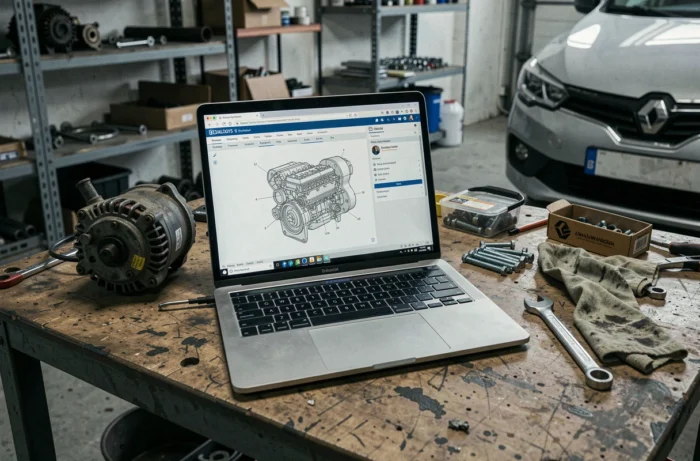
The technical diagrams (exploded views) are the core of the tool. Each mechanical assembly is visually broken down, and each part links to a catalog reference. By clicking on an item in the diagram, the user obtains the original part number, catalog price, and availability.
Cross-referencing the obtained reference with other suppliers remains a common practice. An original Renault part number allows finding an equivalent from third-party suppliers, often at a different price. New Dialogys provides the reliable starting reference, which reduces ordering errors.
Access conditions to New Dialogys: what individuals need to know
The official portal newdialogys.renault.com requires account creation. The creation process directs towards a professional profile: garage owner, dealer, independent technician, or automotive-related organization. Several users on specialized forums report being blocked at the registration stage due to the inability to justify a professional status.
Access for individuals remains a gray area. Renault does not offer a clearly documented public formula on the portal. Field feedback varies on this point: some individuals seem to have gained access through occasional offers, while others have turned to third-party providers like VINsearch.
Regulatory framework and access rights for independents
The issue of access to manufacturers’ technical documentation goes beyond the Renault case. In the UK, the Motor Vehicle Agreements Block Exemption Order 2023 (Competition Act 1998), which came into effect on June 1, 2023, legally guarantees independent repairers access to technical information, tools, and parts from manufacturers.
In continental Europe, similar provisions exist under the block exemption regulation. Independent garages have a legal right to access this data, although practical implementation varies by manufacturer. For Renault, New Dialogys serves as the official channel for provision.
Technical documentation for Renault beyond the parts catalog
Reducing Dialogys to a simple spare parts catalog would be reductive. The portal integrates several layers of documentation that meet distinct needs:
- Repair methods detail manufacturer procedures step by step, including torque specifications, disassembly sequences, and specific points of vigilance for each model.
- Electrical diagrams cover the complete wiring of the vehicle, a recurring need for diagnosing intermittent faults or installing accessories.
- Standard times indicate the reference duration for each operation, a billing basis in authorized networks and a useful benchmark for independents.
This documentation is continuously updated, unlike the old software that required manual updates via DVD or download. A recently marketed vehicle appears in New Dialogys without additional delay.
Reliability of references and limitations of the online tool
New Dialogys reflects the official Renault catalog, which gives it greater reliability than third-party databases compiled through scraping. The available data does not allow concluding on the absolute completeness of the tool, especially for very old vehicles or low-volume special series.
A technical point to note: the platform operates entirely in the browser, without local installation. This implies a dependence on internet connection and Renault servers. Users of the old offline Dialogys could consult data without a network, an advantage that has disappeared with the migration.
For professionals who use the tool daily, the stability of the connection and the loading speed of exploded views directly condition productivity. Feedback on forums is generally positive regarding the portal’s responsiveness, with occasional slowdowns reported during peak usage.
The transition from Dialogys to New Dialogys marks a completed technological shift. The reliable part reference remains the starting point for any order, whether through the official portal or a third-party aggregator. Checking compatibility via the VIN before any order remains the most effective precaution to avoid returns and assembly errors.