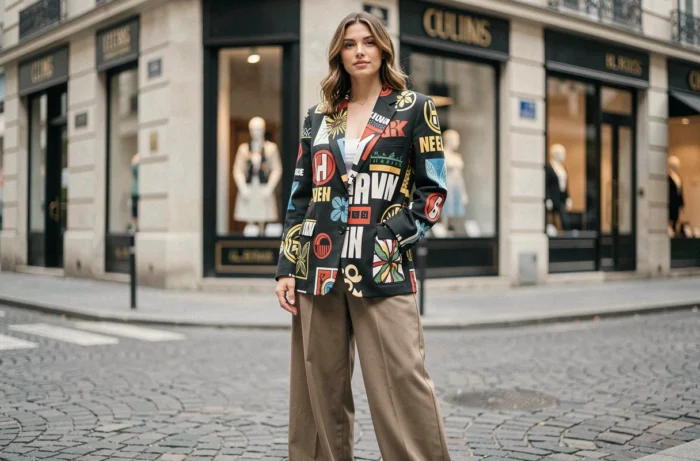
Perry Ah Why and Savage Culture share a trait that major brands cannot claim: a deliberately restricted distribution, driven by networks of independent multi-brand boutiques. This positioning, far from being a handicap, gives them immediate visibility among a clientele that shuns the codes of mass luxury. Understanding what technically distinguishes these two labels allows for a grasp of an under-documented aspect of fashion trends for 2024.
Pattern Making and Textile Construction at Perry Ah Why
Perry Ah Why works with asymmetrical pattern bases, a choice that structures the entire collection rather than just a few isolated pieces. The cuts do not follow the classic shoulder-waist-hip lines: they shift the garment’s support points to create a drape that plays with volume without resorting to rigid materials.
The choice of fabrics follows this logic. We frequently observe the use of fluid knits with low elastane, which accompany the cut without constraining it. The result is silhouettes that move, far from the structured stiffness that many French designer brands offer in the same price segment.
This approach requires meticulous assembly. The interior finishes (flat seams, bias binding) reveal a craftsmanship that recalls more of a small workshop series than semi-industrial production. For a brand distributed mainly through concept stores and selective e-shops, this is a concrete selling point for buyers who systematically turn the garment inside out before trying it on.
Among the brands Perry Ah Why and Savage Culture, the former stands out for its emphasis on cut, which takes precedence over pattern or color. The visual identity is conveyed through form, not through print.
Savage Culture: Printed Textiles as Fashion Signature
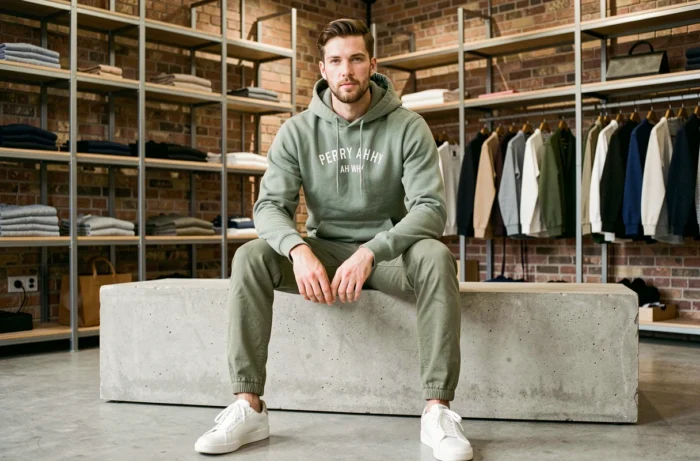
Savage Culture takes the exact opposite approach. The brand builds its identity around saturated graphic patterns and vibrant color palettes, applied to relatively classic cut bases. The garment functions as a canvas for the print, not the other way around.
This technical choice has a direct consequence on manufacturing. The fabrics used must withstand dense prints without losing flexibility or shape after washing. Savage Culture favors blended fibers (cotton-viscose, cotton-modal) that absorb ink well and maintain color brightness over time.
Three Markers that Identify a Savage Culture Piece
- All-over patterns that do not repeat symmetrically from one panel to another, giving each piece an almost unique appearance once assembled
- A color layering technique (three to five layers of print) that produces a visual depth absent in standard digital prints
- Straight or slightly flared cuts, intentionally simple to allow the pattern to carry the entire silhouette
In-store, the effect is immediate: a Savage Culture piece can be spotted from several meters away. This strong visual readability explains why the brand performs particularly well in multi-brand spaces where it stands out from more subdued neighboring offerings.
Selective Distribution and Fashion Trends 2024
The distribution model shared by these two brands deserves attention, as it reflects a structural movement in fashion in 2024. The rise of independent multi-brand boutiques as the main channel for discovering designer brands reshapes the relationship between visibility and desirability.
Neither Perry Ah Why nor Savage Culture seeks to saturate the market. Their presence is concentrated in selected points of sale, often city center boutiques or concept stores with high customer loyalty. This restricted network creates a sense of rarity that, paradoxically, enhances demand.
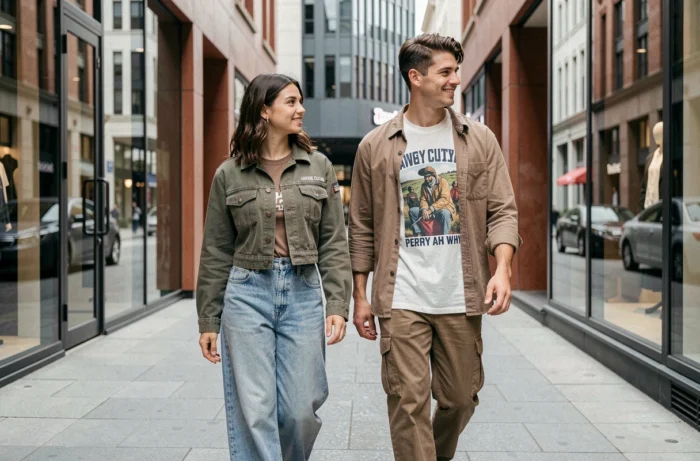
This model stands in stark contrast to that of major houses, whose 2024 strategy remains focused on proprietary retail and high-volume digital marketplaces. We recommend not to confuse the two approaches: buying Perry Ah Why or Savage Culture online most often goes through curated multi-brand e-shops, not generalist platforms.
What This Model Changes for the Buyer
- More specialized in-store advice, as retailers who carry these brands generally know the collections in depth
- Limited restocks that require quick decisions on a piece, especially mid-season
- A stronger stylistic coherence in the overall display of the store, facilitating associations between complementary brands
Perry Ah Why and Savage Culture in the Face of Discreet Luxury
The trend of discreet luxury, widely documented in fashion analyses for 2024, does not directly concern these two brands. Perry Ah Why approaches it through the sobriety of its cuts, but the asymmetrical construction creates a visual shift that distances it from pure minimalism. Savage Culture, with its saturated prints, is at the opposite end of discretion.
These two labels occupy a stylistic space that discreet luxury leaves vacant: that of the piece with a strong personality, worn for itself and not to signal socio-economic belonging. In 2024, this space attracts a clientele that rejects both visible logos and the uniformity of a streamlined wardrobe.
The complementarity between the two brands also serves as an indicator of taste. Wearing Perry Ah Why with Savage Culture implies a mastery of the balance between structure and color, between restraint in cut and exuberance in pattern. It is a style exercise that requires a trained eye, exactly the type of approach that independent boutiques that distribute them value.
The fact that these two brands are gaining visibility without going through the usual circuits of fashion week or massive advertising campaigns confirms a reconfiguration of the fashion landscape. Prescription is shifting towards specialized retailers and communities of informed buyers, a movement that analyses focused on Paris, Milan, or New York tend to underestimate.