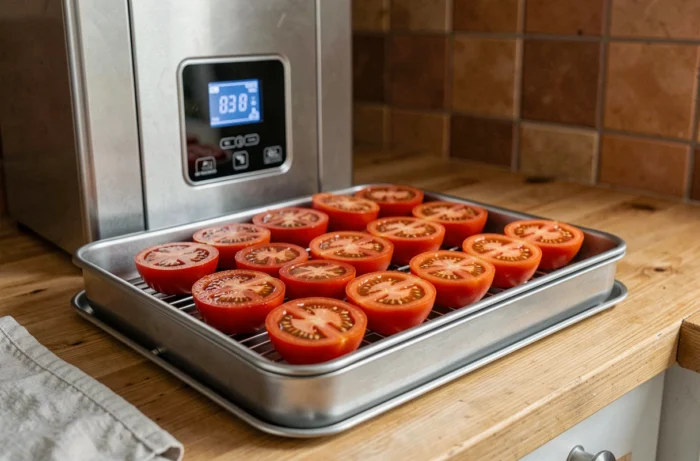
The tomato contains about 94% water. This ratio governs the entire dehydration process: yield, duration, thermal setting, and especially the surface crusting trap. Successfully making homemade dried tomatoes in an electric dehydrator relies less on the recipe than on mastering a few technical parameters that most guides overlook.
Surface Crusting and Managing the Water Gradient
The main flaw of homemade dried tomatoes is a tough skin that encases a still moist core. This phenomenon of surface crusting occurs when the initial temperature is too high: the outside dries and hardens before the water from the center has migrated to the periphery.
To avoid this, we recommend starting at a low temperature, around 50 °C, for the first two hours. This phase allows for slow evaporation that establishes a consistent water gradient between the core and the skin of each slice.
After this gradual increase, the cruising temperature is in the 57-63 °C range. This range ensures uniform dehydration without cooking the flesh. Beyond 65 °C, natural sugars begin to caramelize and the texture becomes brittle instead of remaining flexible.
A point often overlooked: rotating the trays. Even on a horizontal flow dehydrator, trays close to the heat source dry faster. Switching the trays every three to four hours corrects this imbalance.
Tomato Varieties and Cutting Thickness for the Dehydrator
Meaty varieties, low in seeds and free water, yield the best results. Roma remains the reference, but heart-shaped varieties offer a better flesh-to-water ratio than classic round tomatoes. Cherry tomatoes, halved, also work very well due to their sugar concentration.
We advise against low-acid varieties: they darken during dehydration and develop bitter flavors. If you only have tomatoes of this type, adding a splash of lemon juice or vinegar before drying partially compensates for the lack of acidity.
The thickness of the cut directly affects the drying time. Here are the benchmarks we use:
- Slices of 6 to 8 mm: complete drying in eight to twelve hours at 60 °C, soft texture, ideal for storage in a dry jar
- Half cherry tomatoes: ten to fourteen hours depending on size, concentrated and slightly sweet result
- Thick wedges (over 12 mm): very long drying time, increased risk of crusting, reserved for semi-dried confit tomatoes consumed quickly
Removing the seeds and inner gel before placing the slices on the trays reduces drying time and improves the consistency of the result. Anyone wishing to make dried tomatoes with a dehydrator under the best conditions will save time on this preparation step rather than increasing the temperature.
Preservation of Lycopene and Drying Temperature
Lycopene, the main antioxidant in tomatoes, is sensitive to prolonged heat. Recent technical studies on dehydrated tomato pulp show that a temperature range of 45 to 55 °C increases the retention of bioactive compounds, including vitamins and the characteristic red color.
In practice, drying exclusively at 50 °C doubles the total duration of the process. The compromise we apply is to maintain 50 °C during the first third of the drying (when nutrient loss is fastest at high temperatures), then increase to 60 °C for the remainder.
Color is a reliable indicator: dried tomatoes that turn dark brown have undergone excessive heat. The desired result is a dark red leaning towards burgundy, soft to the touch, without shiny areas of residual moisture.
End of Drying Test and Storage Errors in Oil
The most reliable test remains bending. A properly dried tomato bends without breaking and leaves no trace of moisture at the bending point. If water beads, drying must continue. If the slice breaks cleanly, it is too dry for typical culinary use (it remains usable when reduced to powder).
Weigh your production before and after drying. The expected ratio is around 1 to 13: 2 kg of fresh tomatoes yields about 150 g of dried tomatoes. A significantly higher yield indicates incomplete drying.
The Trap of Storing in Olive Oil
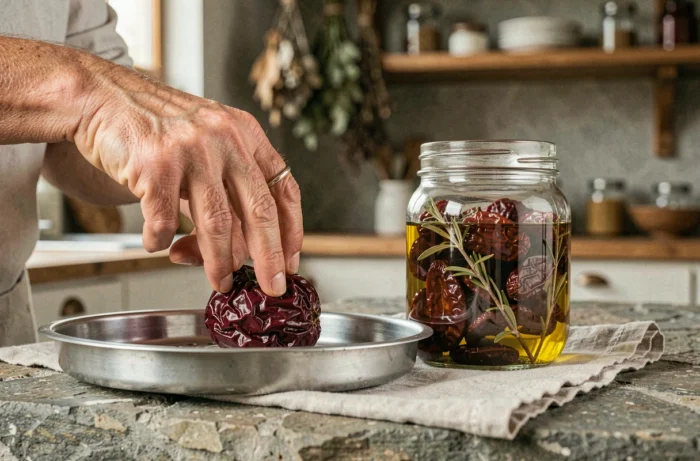
Covering dried tomatoes with olive oil creates an anaerobic environment, exactly the setting in which Clostridium botulinum thrives. A dried tomato has lost much of its natural acidity and no longer protects against this risk.
Recent recommendations are strict:
- Storage in oil only in the refrigerator, never at room temperature
- Consumption within a few days to a maximum of two weeks
- Prefer dry storage in an airtight jar, in the freezer for long-term preservation (several months without degradation)
- If you insist on oil, acidify the tomatoes with white vinegar before immersion to lower the pH
This food safety point is the most underestimated in mainstream recipes. A jar of tomatoes in oil forgotten in a cupboard for several weeks poses a real risk.
Settings According to the Type of Electric Dehydrator
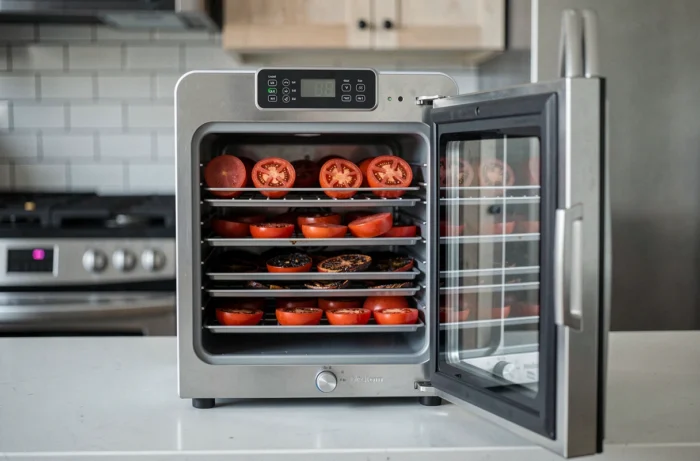
Vertical flow dehydrators (fan at the bottom or top) require more frequent tray rotation than horizontal flow models. On a vertical device, slices placed in the center of the tray dry more slowly than those on the periphery.
On a horizontal flow dehydrator, air circulation is more even, but the usable capacity per tray is often lower. In both cases, never overlap the slices and leave at least one centimeter of space between each piece to allow for air circulation.
A final adjustment often overlooked: leaving the door ajar for the first thirty minutes expels the initial excess moisture and speeds up the critical phase where crusting is likely to form. This technique works on most home devices.
The success of homemade dried tomatoes ultimately depends on mastering three parameters: a gradual temperature increase, a consistent cut suited to the variety, and storage that respects microbiological constraints. The rest is a matter of patience, as a complete cycle rarely exceeds fourteen hours for a result that can be stored for months in the freezer.