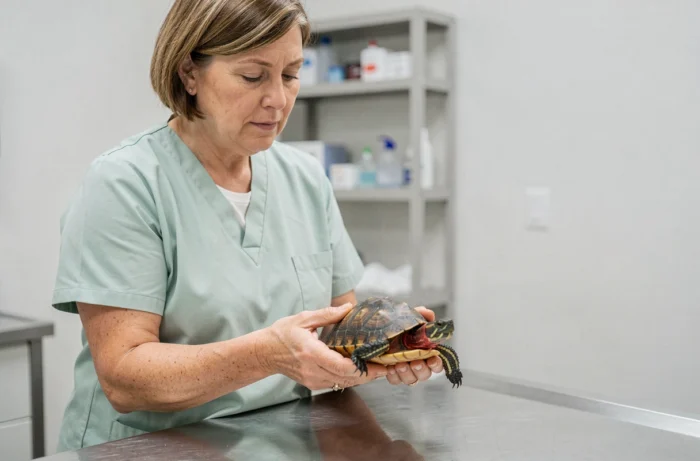
You find your turtle motionless at the bottom of the terrarium or buried in the garden soil, and doubt sets in. The problem is that a turtle in brumation closely resembles a dead turtle: no movement, no reaction to touch, limbs retracted. Distinguishing between these two states requires precise actions, because relying on general appearance is not enough.
Muscle Tone of the Limbs: The Test That Owners Forget
Most online guides talk about smell, sunken eyes, or lack of movement. These criteria come late, sometimes several days after death. The first reflex to adopt is to check the muscle tone of the legs.
Gently pull on a front or back leg. A living turtle, even deeply asleep or in brumation, will resist. The limb slowly returns to the body once released. In a deceased turtle, the leg remains limp, hanging, with no retraction. This tone test is routinely used by veterinarians specializing in reptiles to make a quick determination.
An owner observing the signs of a dead turtle should combine this test with two other checks before concluding: the response to light (pupil contracting under a beam of light) and the micro-respiratory movements at the throat or cloaca in aquatic species.
Warm Turtle After Death: Why Shell Temperature Can Be Deceptive
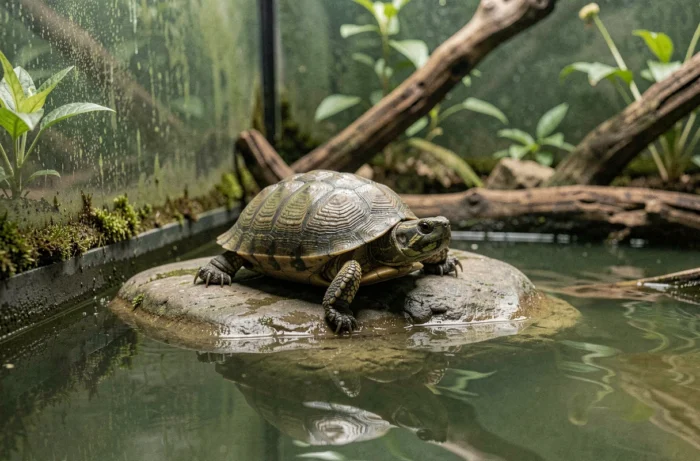
It is often believed that a turtle that still feels warm to the touch is necessarily alive. The shell has insulating properties that allow the body to retain its heat for several hours after death. In a heated terrarium or during summer in an outdoor enclosure, this thermal retention lasts even longer.
Therefore, never rely solely on the temperature of the shell. This is a classic trap that delays awareness and, at times, veterinary consultation.
What to Check in Addition to Temperature
- The response to a light pinch of the skin between the back legs: a living turtle will contract the stimulated area, even slightly
- The palpebral reflex: a light touch at the corner of the eye causes blinking or retraction in a living animal
- The state of the jaw: in a turtle that has been dead for a few hours, rigor mortis often begins with the jaw, which becomes difficult to open
Brumation or Death: Distinguishing Between the Two in Winter
Confusion is common between October and March. A Hermann’s turtle in a shelter in the garden or placed in a box in the refrigerator for controlled hibernation can remain completely motionless for weeks. Body temperature drops, and breathing becomes nearly imperceptible.
A turtle in brumation retains some residual tone in its limbs. Even without visible movement, the leg that is gently stretched offers minimal resistance. The body does not emit any unusual odor, and the eyes, although closed, are neither sunken nor dried out.
In contrast, a dead turtle during hibernation will eventually show a softening of the plastron, a gradually developing odor, and completely flaccid limbs. Reports vary on the timing of these signs depending on ambient temperature, but in cool conditions (around 5 to 10 degrees), the odor can take several days to become noticeable.
Temperature Monitoring During Hibernation
Regular monitoring of the temperature in the shelter or refrigerator helps avoid accidents. If the temperature drops too low or rises sharply, the turtle can die without the owner noticing before the end of the hibernation period. A min/max thermometer placed next to the animal provides a reliable reading without handling.

When to Consult a Veterinarian Specializing in Reptiles
If doubt persists after the tone tests, palpebral reflex, and respiratory observation, only a specialized veterinarian can make a definitive diagnosis. General veterinarians do not always have the necessary experience to properly assess the condition of a reptile.
Two situations justify a quick consultation:
- The turtle does not respond to any stimulus but shows no odor or rigidity: it may be in a state of pathological lethargy related to an infection or severe hypothermia, and prompt intervention may save it
- The turtle emerges from hibernation but remains completely apathetic after several days at normal room temperature: a metabolic problem or a disease contracted during brumation (the immune system being dormant during this period) may be involved
- Unusual secretions appear at the nose, mouth, or cloaca, accompanied by prolonged immobility
An animal taken to the veterinarian in the first hours of doubt has a better chance than one left under passive observation for days.
Handling the Body After Confirmation of Death
A dead turtle should not be left in the enclosure or terrarium. Decomposition poses a health risk, especially if other animals share the space. Turtles can carry salmonella, and handling the body without precautions exposes the owner.
Wear gloves, place the body in a sealed bag, and contact the veterinarian or the town hall to find out about local options: cremation through a specialized service, or disposal in a rendering plant according to municipal regulations. Burial in the garden is tolerated in some municipalities for small animals, but the rules vary from one area to another.
Last precaution often overlooked: clean and disinfect the enclosure or terrarium before placing another animal in it. A turtle that died from an infection may have contaminated the substrate, bowls, and water surfaces.