
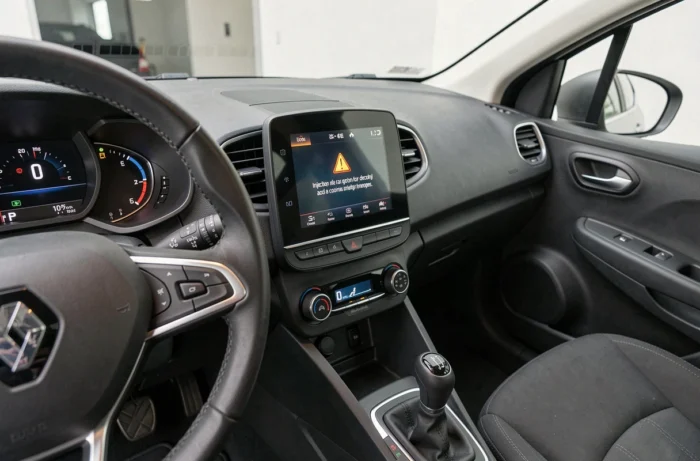
The message “injection to be checked” on Clio 5 does not always point to the fuel circuit. The engine control unit groups under this alert voltage, frequency, or pressure discrepancies from sensors that are sometimes very far from the injection rail. Understanding the logic of fault code reporting helps avoid unnecessary part replacements and target repairs from the first intervention.
Fault DF113 and air conditioning pressure switch: when injection is not the issue on Clio 5
One case we are encountering more frequently in the workshop deserves to be addressed first because it generates costly erroneous diagnostics. The code DF113, related to the refrigerant pressure sensor (air conditioning pressure switch), is reported via the injection control unit and triggers the message “injection to be checked” accompanied by the orange key warning light.
The injection circuit is mechanically sound. The problem lies on the shared 5 V line among several sensors, including the pressure switch. A drop in voltage on this line is enough to trigger the control unit’s injection alert, even though neither the injectors, nor the pump, nor the rail show any anomalies.
According to an analysis by GarageMag on DF113 cases in 2026, about 60% of failures are resolved by simply cleaning the 3-way connector, without changing any components. Oxidation of the pins or a poor connection in the harness is enough to trigger the alert. A technician who focuses on the injection circuit without checking the pressure switch’s connector wastes time and charges for unnecessary parts.
A detailed resource on the control unit and injection to be checked on Clio 5 explains how the control unit records these discrepancies and why the label displayed on the dashboard does not always correspond to the faulty component.

Shared 5 V line and misleading fault codes on Clio 5 control unit
The engine control unit of the Clio 5 powers several sensors on the same 5 V reference line. This architecture is common in recent Renault engines, but it has a direct consequence on the interpretation of fault codes: a faulty sensor can contaminate the readings of other sensors on the same line.
Specifically, if the rail pressure sensor (DTC code type P0190 or P0191) shares its 5 V reference with the atmospheric pressure sensor or the air conditioning pressure switch, a failure in one of them causes the reference voltage to drift. The control unit then records multiple codes simultaneously, which muddles the diagnosis.
Method for sorting multiple codes
When the OBD reading returns three or four codes at the same time, we recommend proceeding by elimination on the 5 V line:
- Disconnect each sensor powered by the same reference one by one, measuring the voltage at each disconnection. If the voltage returns to 5 V after disconnecting a sensor, that sensor is pulling the line down.
- Check the condition of the connectors (oxidation, spread pins, water infiltration) before suspecting the sensor itself. The majority of faults reported in 2026 for this type of alert are related to the connectors, not the components.
- Do not erase the codes before noting the order of appearance (freeze frame). The first recorded code is often the source code, with the subsequent ones being consequences of the voltage drift.
Degraded mode and power loss: what the engine control unit actually limits
When the control unit detects a discrepancy in the injection circuit, it may activate a degraded mode that limits engine speed and the amount of fuel injected. On the Clio 5, this limitation does not always manifest in the same way depending on the recorded fault code.
A fault in the rail pressure sensor generally leads to a clear limitation of torque, noticeable at low RPMs. The driver feels a significant loss of power, sometimes accompanied by jerks during acceleration. The control unit protects the injection rail by reducing the set pressure.
A fault in the EGR valve or the DPF, on the other hand, causes a more gradual degraded mode. Power decreases gradually, especially under load. The message “injection to be checked” appears, but the driving behavior remains acceptable in urban driving. This leads many users to delay diagnostics, risking worsening the clogging of the particulate filter.
Differentiating mechanical urgency and electrical fault
A degraded mode with jerks and smoke requires a quick stop of the vehicle. This scenario points to a fuel pressure problem (high-pressure pump, regulator, stuck injector) that can damage the catalyst or turbo if the engine continues to run.
A degraded mode without smoke, without abnormal noise, and without sudden RPM variation leans more towards a sensor or connector fault. In this case, driving cautiously to the workshop remains feasible, provided the engine is not loaded.
OBD reading on Clio 5: DTC codes and freeze frame to utilize
The OBD port of the Clio 5 is located under the steering wheel, on the left side. A reader compatible with the CAN protocol is necessary to access Renault manufacturer codes (prefix DF) in addition to generic OBD-II codes (prefix P).
Generic codes provide guidance, but DF codes give details about the affected circuit. For example, a P0201 (injector control circuit cylinder 1) is useful, but the corresponding DF code specifies whether the fault is an open circuit, a short circuit to positive, or a short circuit to ground. This distinction completely changes the repair method.
- P0190 to P0194: rail pressure sensor (signal out of range, open circuit, performance).
- P0201 to P0204: injector control circuits (one code per cylinder).
- P0401: insufficient EGR flow, often confused with an injection fault by the dashboard message.
- DF113: refrigerant pressure sensor, reported by the injection control unit despite belonging to the air conditioning circuit.
The freeze frame associated with each code records the engine conditions at the time of the fault (RPM, temperature, load). Cross-referencing this data with the code allows confirming whether the fault appeared when cold (often connector-related) or under load (often mechanical).
On the Clio 5, the number of codes recorded simultaneously provides a reliable indication of the nature of the problem. An isolated code with a coherent freeze frame points to a specific component. Three or more codes on the same line of sensors indicate a wiring or common ground fault, to be addressed before any part replacement.