
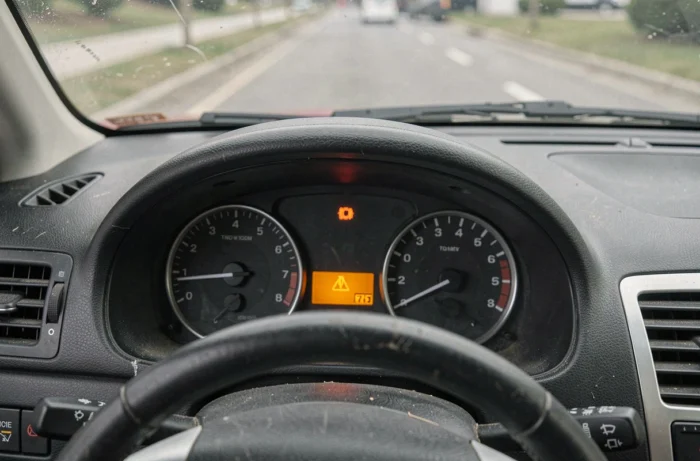
The tank has just been filled, the cap is screwed back on, and during the next start, the orange engine light illuminates on the dashboard. The car runs normally, with no suspicious noises or loss of power. This situation is common and rarely related to a serious malfunction, but it deserves to be understood to react appropriately.
EVAP Circuit and Engine Light After Refueling: The Hidden Mechanism
Most articles about the engine light list generic causes (lambda sensor, catalytic converter, injection). Before getting there, it is essential to understand a system that few drivers know: the fuel evaporation circuit, called EVAP.
This circuit prevents gasoline vapors from escaping into the atmosphere. It includes an activated charcoal canister, hoses, a purge valve, and the fuel cap itself. The vehicle’s computer regularly tests the tightness of this circuit.
The key point: this automatic test does not trigger just anytime. It depends on the fuel level. When the tank is very full, the test is often postponed. It is while driving, when the level drops into an intermediate range, that the computer initiates the check. If a micro-leak exists somewhere in the circuit, the light may come on several kilometers after refueling, not immediately at the pump.
As explained by the Ceze website regarding the engine light, this correlation between refueling and the orange light coming on is one of the most common cases encountered by drivers.
Improperly Closed Fuel Cap: The Simplest Cause to Check
Have you ever heard that little “click” when screwing the cap back on after refueling? If it’s missing, the EVAP circuit is no longer sealed. The computer detects a leak and turns on the engine light.
An improperly closed cap is the primary cause of the engine light after refueling. The solution is obvious: stop, unscrew the cap, and then screw it back on firmly until it clicks. On some vehicles, the light goes off after a few driving cycles (starting, driving, stopping). On others, the fault code must be cleared with a diagnostic tool.
The cap’s seal may also be to blame. Over time, this rubber seal hardens or cracks. A cap that seems well closed can still allow enough air to trigger the alert. Replacing a fuel cap costs a few euros and resolves the issue in many cases.
EVAP Micro-Leaks: When the Orange Light Persists Despite a Correct Cap
Recent pollution control systems have become very sensitive. They detect leaks as small as half a millimeter, generating fault codes like P0456 (small EVAP leak). A slightly cracked plastic fitting, a hose cracked by heat, or a worn purge valve is sufficient.
The trap: the car runs perfectly and no symptoms are noticeable. No loss of power, no gasoline smell, no noise. The driver thinks it’s a bug. In reality, the computer has detected a real fault, simply invisible during daily use.
These micro-leaks do not pose an immediate danger to the engine. However, they can cause issues during technical inspections, as pollutant emissions slightly increase. An OBD diagnosis allows for precise identification of the faulty component.
What an OBD Diagnosis Reveals in This Case
By connecting a diagnostic tool to the vehicle’s OBD port, the mechanic (or the driver equipped with a portable reader) retrieves a fault code. The most common codes after refueling are:
- P0456: very small leak detected in the EVAP circuit, often a seal or fitting
- P0455: larger leak in the EVAP circuit, possibly indicating a missing cap or a defective canister
- P0440: general malfunction of the EVAP system, requiring a complete visual inspection of the circuit
- P0444: open circuit on the canister purge valve, an electrical component that needs replacement
These codes directly guide the search. Without a diagnosis, a mechanic may look towards the injection or lambda sensor, which prolongs the intervention time and the bill.

Fixed or Flashing Engine Light After Refueling: Two Very Different Situations
The distinction is crucial. A steady orange engine light indicates a pollution control fault or a sensor issue. The car can generally continue to drive to a garage without immediate mechanical risk.
A flashing orange engine light, on the other hand, indicates an active combustion problem, typically misfires. In this case, unburned fuel reaches the catalytic converter and can damage it within minutes. Speed should be reduced, sharp accelerations avoided, and the car should be taken to a garage as soon as possible.
After refueling, a flashing light may signal poor-quality fuel or a pump error (gasoline in a diesel, for example). This situation is rarer but significantly more serious than a simple EVAP fault.
When the Limp Mode Activates
Some vehicles enter limp mode when the light is flashing. Power is intentionally limited by the computer to protect the catalytic converter and the engine. If your car suddenly loses power right after refueling, turn off the ignition, wait a minute, then restart. If limp mode persists, do not force the vehicle and have it towed.
What to Check Yourself Before Going to the Garage
Before making an appointment, a few simple checks may be enough to resolve the issue or guide the diagnosis:
- Firmly screw the fuel cap back on and drive normally for two to three complete trips to see if the light goes off by itself
- Visually inspect the cap seal: if it is flattened, hardened, or cracked, replace it
- Check that no gasoline smell is detectable around the tank or under the hood, which would indicate a more serious leak
- If you have an OBD reader, connect it to read the fault code before heading to the garage: this saves time for the mechanic
An orange engine light after refueling, when the car runs normally, is mostly related to the EVAP circuit or the fuel cap. The most useful reflex is to check this cap immediately, then read the fault code if the light persists after a few trips. Keeping this code handy simplifies every exchange with the mechanic and avoids unnecessary interventions.