
The wedding after-party focuses on a simple promise: to reconnect with the people who matter in a setting free from the previous day’s protocol. The guest list for this post-wedding gathering is not constructed like that of the main reception. It follows different criteria, often more emotional than social, and some practical constraints should be established before sending out invitations.
Wedding After-Party and Local Regulations: A Often Overlooked Factor
Before even thinking about the guests, the legal framework of the venue deserves a check. Since the summer of 2026, several municipalities and prefectures have tightened restrictions on unregistered festive musical gatherings, including events like the day after a wedding. An after-party in a private garden or rented estate may require prior declaration if sound equipment is planned.
This point is not trivial: it determines the number of guests you can reasonably accommodate. A venue subject to neighborhood constraints or strict hours naturally pushes towards a more intimate format. Checking these elements in advance avoids having to reduce the list at the last minute, which always generates frustrations.
For those looking to successfully host their wedding after-party with Univers Mariage, the question of the venue and its constraints is a good starting point before deciding on the guests.
Wedding After-Party Guest List: The Criteria That Really Matter
The classic temptation is to re-invite everyone. This is rarely a good idea. The wedding after-party works better in a small committee, in an atmosphere where each person present has a clear reason to be there.
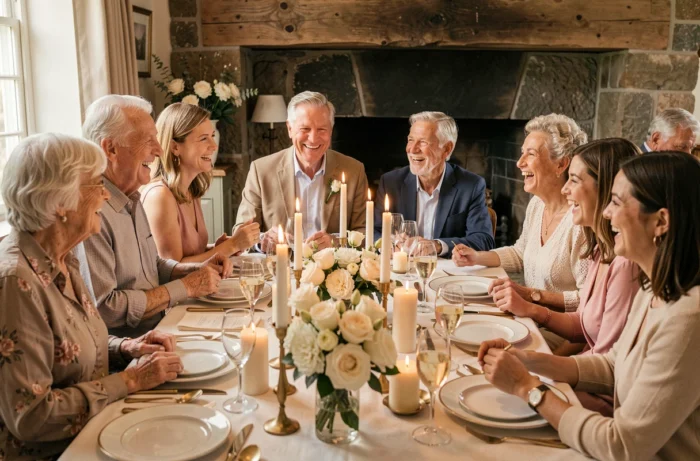
Three categories of guests consistently appear in successful wedding after-parties:
- The immediate family from both sides, especially those who traveled from afar and are leaving the next day. These are often the people with whom the couple exchanged the least during the reception.
- The witnesses and friends who actively participated in organizing the wedding. The after-party is often the first moment they can finally relax.
- The people who helped on the big day (coordination, logistics, setup). Thanking them over a relaxed meal holds more value than a message sent three weeks later.
Inviting between twenty and fifty people remains the most common range. Beyond that, the atmosphere shifts towards a second reception, which is neither the goal nor the budget planned.
The Question of Children
If the wedding was organized without children, the after-party offers the opportunity to include them. An outdoor brunch or a barbecue in a garden is well-suited for their presence. However, if the venue imposes noise or space constraints, it’s better to remain consistent with the chosen format.
Evening Guests Only
Some guests were only present for the dance party and only crossed paths with the couple for a few minutes. Re-inviting them to the after-party depends on the actual connection, not on the fact that they were there the night before. A childhood friend who came only for the evening deserves a spot at the brunch. A friendly but distant colleague, probably not.
Embracing a Small Format: A Trend That Simplifies Decisions
Recent feedback on weddings shows a clear evolution. Small formats are gaining ground in wedding trends, and the after-party is no exception to this movement. Inviting fewer people is no longer seen as a budget constraint; it is a choice embraced by more and more couples.
An after-party with around fifteen carefully selected people allows for long conversations, a shared meal without a seating plan, and a day that doesn’t resemble the day before. It’s precisely this shift that makes the moment memorable.

The smaller format also has a practical advantage: it opens up venue options that would be impossible to consider with fifty guests. An apartment, a restaurant terrace, a picnic organized in a park. Fewer guests mean more freedom regarding the venue and the type of meal.
Wedding After-Party: What to Avoid in the Guest List
Some mistakes frequently recur and deserve to be addressed frankly.
The first: inviting out of social obligation. The after-party is not a second reception. If a wedding guest does not have a strong connection with the couple, their absence the next day will go unnoticed. However, their presence can dilute the intimate atmosphere sought.
The second: forgetting to inform in advance. After-party guests should know before the wedding that they are invited to the day after. A message slipped at midnight on the dance floor doesn’t work. Integrating the information into the invitation or pre-wedding communication remains the most reliable method.
The third: not setting a clear limit. Without a defined maximum number in advance, the list inflates with successive additions. Setting a number and sticking to it protects the budget, the atmosphere, and the logistics of the meal.
The Case of Vendors and Venue Staff
If the after-party is held at the same venue as the wedding, the staff present the next day is part of the equation. Confirming the exact number of guests with the caterer or venue at least two weeks before the wedding avoids unpleasant surprises regarding quantities and service.
The most successful after-party is often the one where each person present feels they belong. This filter, applied name by name on the list, is usually enough to resolve any hesitations.